The Phantom Time Theory
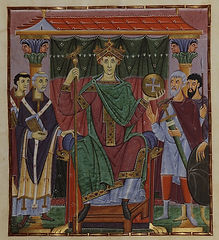
I originally heard about this notion – I hesitate to call it an historical theory – on an episode of QI and immediately found it both fascinating and ludicrous. It is a hypothesis/conspiracy theory of a German historian, Heribert Illig that is centred on the supposed wish of 10th century Holy Roman Emperor, Otto III, and Pope Sylvester II, to live and reign during the prophetic year AD1000. In order to do, the hypothesis states that he ordered the re-dating or even the invention of the period 614-911 through the doctoring of the historical and archaeological record.
In a most drastic reading of this hypothesis, it states that the 297 years between 614-911 did not happen and that in fact we are currently living in the year 1729 rather than 2026. Illig bases much of his theory on the presence of Roman-themed architecture in 10th century western Europe, the relationship between the Julian and Gregorian calendar and the lack of archaeological and dendrochronological evidence from that period or that it is so poor that it is only explainable as a poor attempt at faking it.

We have seen additions of ‘phantom time’ on a smaller scale with the imposition of leap days and intercalary months, and the updating of the calendar, complete with the addition of days, to keep in time with the seasons. We have become used to the idea that political leaders can suppress/promote their version of events but it is rather spectacular to think that a potentate might have the power to erase/create entire centuries of history and have them accepted as having happened to such an extent that people write books about them...
Maybe a couple of my books and several blogs have been based on a lie...
But then how to explain the myriad political developments that are recorded to have happened between 614 and 911? If you look at a map of c.600 and then of c.900, there are a lot of changes…
how the Muslims unified Arabia and then conquered everything from Spain through North Africa, the Middle East, Iraq, Iran, central Turkey, the Caucasus, Afghanistan, Central Asia and northern India in a single year
did the Viking raids/conquests not take place?
if they didn't, where did that massive Russian principality come from?
how did the Frankish empire collapse overnight?
where did the Persian/Visigoths/Avars disappear to?
Also, wouldn't calendars from other areas of the world that had never heard of this emperor refute this? As in they have the missing 300 years? Hasn't China been around for thousands of years? Wouldn't they have records that could refute this?
Certainly, astronomical data proves that the period 614-911 did take place. And contrary to some of Illig’s claims, archaeology and dendrochronology refute the idea of ‘phantom time’. Illig has also made a fundamental error in his dealings with the Julian and Gregorian calendar, which he uses to hypothesis his ‘missing three centuries’. The Gregorian reform corrects the issues of a drifting vernal equinox (used in the calculation of Easter Sunday) between the Julian calendar of AD325 – the date of the Council of Nicaea – and in the 16th century, not between the 16th century and the original institution of the Julian calendar in 45BC. In essence, the years between 45BC and AD325 are the basis of Illig’s missing centuries, as they would seem to have not been taken into account by the reform – with the jump then made that a period of over 300 years did not happen. Except the setting of the vernal equinox as 21 March in AD325 somewhat accounted for those 300+ years of equinox drift, seen in the Julian calendar of 45BC having the vernal equinox on 23 March. Speaking of calendars, the existence of the Islam calendar is perhaps why Illig chose 614 as the starting point of his phantom time period, cutting out the historical sections of the Qur’an as well.

Illig’s hypothesis being so patently disprovable might actually make it of more use in stirring up investigation. If you say something even remotely sensationalist, people will come out of the woodwork to disprove you, but at the same time become engaged in the subject matter. This could see Illig’s hypothesis as less a conspiracy theory out to change the world in the same way that there are Holocaust and moon-landing deniers or ‘inside job’ 9-11ers, but rather more of a theory like say Feynman’s Single Electron Universe theory that takes advantage of a scenario/situation that we do not fully understand and presenting a potential explanation, even if it is completely out of left field.
In such a view, would it really be surprising to find out that Illig was an historian of the Early Medieval/Early Byzantine period and was using such sensationalism to increase interest in his own subject [instead, Illig already had form in invented chronological revisions when looking at prehistory and Ancient Egypt – he is a really a pseudo-historian and contrarian]?
The period AD600-900 is one of the most under-studied periods, perhaps solely because of the lack of good primary sources but is at the same time one of the most important periods in history: collapse of Persia, cowing of Rome, rise of Islam, Viking raids, the forging of many of the modern states of Europe (England, France, Germany, Russia, Norway, Sweden, Denmark).
Having spent much of the last decade reading the primary sources for the seventh century and not being able to find a good reason for the written record to be so poor given that we have so many different cultures writing all at the same time, there is definitely room for a hypothesis. It is an entirely ludicrous jump to say that the record is so poor because it never happened, but there is that gap in knowledge there.
Attempting to explain the jump in politics, religion etc. needed to explain the Phantom Time Theory could present a rather interesting counter-factual history – ‘how is the world of AD911 actually that of AD615?’


Comments