The Impact of Christianity on Roman Military Service Part III
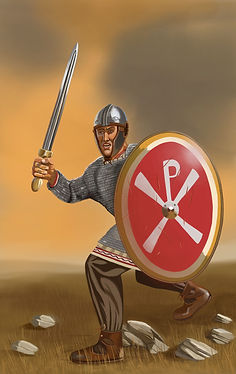
The gradual Christianisation of the Empire during the fourth century brought new challenges and moral dilemmas for Christians. Positions of authority exposed them to ‘the inescapable ambiguities involved in managing temporal affairs.’[1] The presence of Christians in the Roman army now had to be accepted by those Christians responsible for running the Empire. However, the councils proved that they could be as ambiguous in their pronouncements as earlier scholars. The third canon of Arles denied communion to those soldiers who in times of peace ‘arma proiciunt.’[2] The translation of this phrase can drastically change the meaning of the decree. It could be seen as those ‘who throw down their weapons’ and therefore a condemnation of deserters or it could mean those ‘who thrust out their weapons,’ suggesting a condemnation of soldiers who use their weapons to disturb the peace.[3]
To back Christian military service, ‘Augustine of Hippo developed a theory of the complementarity of the earthly and heavenly cities which legitimated the waging of war by Christian rulers.’[4] Taking up the idea that Christians should support ‘those who are fighting in a righteous cause,’[5] in essence a ‘just war’, Augustine saw military service as vital for peace as long as it was waged for the right reasons.[6] He persuaded the comes Africae Bonifacius to ‘serve God as a soldier in pacifying the barbarians and protecting the church’[7] by encouraging him to see his martial abilities as a divine gift that was to be used to secure earthly peace. Other prominent Christians saw military service as a valuable contribution to society. Ambrose of Milan thought that ‘the kind of courage which is involved in defending the Empire against barbarians, or protecting the weak on the home front or allies against plunderers is wholly just,’[8] while Basil of Caesarea saw it as the church’s duty to pray for ‘those who are enrolled in military service.’[9]
However, despite council resolutions and the support of men like Augustine of Hippo, ‘reservations about the compatibility of Christianity and military service clearly persisted.’[10] Ambrose of Milan and Gregory of Nazianus could not fully support the Roman military due to its continued use of pagan emblems and rituals, particularly the eagle standard.[11] The Christianising of the military oath recorded by Vegetius[12] may not demonstrate the widespread Christianising of the army, as the majority of recruits came from the Gallic and Illyrian peasantry and barbarians tribes where Christianity had made the least headway.[13] It may instead have come from a more confident Christian emperor like Theodosius I who was trying to press the Christianisation of the army by attracting more devout recruits.[14] Others went as far as to encourage pious men to leave the army to take up an ascetic lifestyle.[15] Paulinus of Nola stated that ‘‘if we love this world more, and prefer to be a soldier for Caesar rather than for Christ, we shall later be transported not to Christ but to hell.’[16] While these men were probably more pro-ascetic than anti-military, this still resulted in a loss of recruits. Valens found this a widespread enough problem to deal with it harshly, first condemning monks as deserters[17] and then conscripting them into the army and the mines.[18] Basil of Caesarea had to reprimand Cappadocian bishops for ordaining men as clergy to escape military service.[19] Despite official Church condemnation, religious conviction feigned or otherwise remained an avenue to escape military service and enough men took advantage of this for the government to legislate against it.[20] The expansion of Church lands, the clergy and monks has led to its criticism, alongside the aristocracy and civil servants, as an economically unproductive group of ‘idle mouths.’[21] While some clergy were willing to provide for themselves,[22] the majority posed a financial burden to the state.
However, Christianity could also bolster the military capacity of the Empire. Constantine and later Vetranio used the phrase hoc signo victor eris to unify their armies. The late eastern army in particular benefited greatly from the positive use of Christian beliefs and iconography[23] and Christian holy men may have played a major role in the survival of the Eastern Empire.[24] Christianity could also have aided the recruiting of barbarians and their integration into the Empire.[25] However, this was not a universal feeling as Ambrose of Milan continued to consider Christian barbarians to be the enemies of Rome.[26] Also many barbarian Christians continued to follow forms of Christianity that were considered heretical by the Empire. However, Ambrose was a friend of Arbogast, who was both a pagan and a barbarian. The mixed forces at Frigidus demonstrate that pagans, Arians, Donatists and Nicene Catholics were joining the army in spite of having to serve alongside each other. Christianity also proved adept at mobilising the citizenry to help defend the Empire[27] and is ‘credited with bolstering local morale and hence the security of particular cities; because the defence of individual cities underpinned Roman control of frontier provinces, the Church and its hierarchy became vital elements in the maintenance of Roman authority.’[28]
However, while the sense of community that Christianity bred and the actions of individuals could be helpful to the Empire, the preaching of holy men and their actions could also be damaging. The attributing of all the Empire’s problems to sin could encourage the viewing of a military crisis as the wrath of God. This could be detrimental to recruitment as Christians might be more inclined to pray or look for the intercession of a saint instead of fighting as physical weapons could be seen as useless in the face of divine anger.[29] Recruiting may have dropped not just because Christians felt that fighting God’s wrath was futile but as the state gave resources to the Church that could have been used to raise recruits and mercenaries instead.[30] The wealth of the Eastern Church is shown by its ability to bankroll Heraclius’ campaign against the Persians.[31] This demonstrates that, through tax exemptions, imperial favour, public and private bequests, the Church took financial resources out of normal circulation, draining those available for the state, including army recruiting. The increasing influence of the Church could sway who was permitted to serve in the army. Even at times of great pressure on the Empire, the Church and state could be more interested in completing not just the Christianisation of the army, but its Catholicisation with pagans, Jews and non-Catholics all banned from service.[32] While such decrees were not followed to the letter,[33] they could have dissuaded members of these communities, both Roman and barbarians, from enlisting.
The potential double-edged sword of Christianity can also be seen in the east. Fasting before the battle of Callinicum in 531 possibly undermined the stamina of Belisarius’ army.[34] As ‘the fifth and sixth centuries marked the peak of the monastic movement,’[35] complaints of much needed manpower and funds being diverted away from soldiery and farming to churches and monasteries are also found.[36] This expansion may have seen the sixth century clergy far outnumber imperial civil administration so that ‘the church’s salary alone was far heavier than that of the Empire.’[37] The Church and army continuing to share the same peasant and middle class manpower resources[38] led to a confrontation between Pope Gregory and the emperor Mauricius when the latter attempted to regulate entry into the church, suggesting that some were trying to avoid conscription.[39] However, eastern resilience in the face hardship during the 540s has been attributed to the ‘close interconnection of state and religion.’[40] Clergy are recorded taking up roles in the defence of eastern cities such as Bishop Jacobus at Nisibis[41] and a group of monks at Amida in 502.[42] The eastern emperor was also able to remain at the centre of the state’s religious hierarchy and wield some authority over it such as the acquiescing to Heraclius’ request to use church resources for his military campaigns against the Persians and Arabs.
It is difficult to come to any firm conclusions as to whether Christianity ever directly affected Roman recruitment. Despite the writings of pro- and anti-Christian scholars, there were only two things that could prevent a Christian from enlisting. The first was the Roman state. Up until 312, the Empire technically held an anti-Christian stance. However, on most occasions pragmatism overruled ideology[43] and ‘many Christians for a long time had been able to find a way to exist inside the army structure without encountering trouble.’[44] Persecution was the exception rather than the rule and when it was enacted it was not due to Christians not serving in the army. Without the Great Persecution, Christian martyrs ‘would have completed their military careers and retired into oblivion leaving no trace, undoubtedly the case with many Christian soldiers.’[45] Once Constantine ascended the throne, Christians became an open and willing partner in the Empire and its army. Arguments regarding Christian non-violence and pacifism are beset by the bloody conflicts fought by Christian armies throughout the fourth and fifth centuries and the survival of the east.
However, the only consistent obstacle to a Christian serving in the army was his conscience.[46] While it is unlikely that Origen, Tertullian, Augustine, Ambrose and the martyrs could sway men already serving, future recruits could have been. Some may have agreed that ‘a just man may not engage in warfare.’[47] The question of how representative of Christian opinion these scholars were will always remain. ‘The conflicts which the Christians had with the Roman army were religious, not ethical.’[48] Killing in battle was not a reason for Christians to not serve in the army and the aversion to capital punishment must have dissipated as Christians began to fill positions of authority. The use of army organisation and vocabulary by the Church may have made it easier for a Christian to enlist and as the Empire and then the army Christianised, pagan idolatry and practice became less of an obstacle. Even if the army had not Christianised and men like Ambrose and Augustine had not endorsed ‘just war,’ given the problems that Rome faced in the fourth and fifth centuries, it is difficult to see how loyal Christians could have retained their mission as peacemakers.[49] Also whether such moral thoughts were taken into consideration by the public at large during antiquity before the Church had assumed the all-encompassing position that it achieved during medieval times is impossible to fully ascertain. In the end, upon hearing the teachings of the Bible, even with regional variations in translation and interpretation, Christians would have to make up their own mind.
[1] Louis Swift, The Early Fathers on war and military service, Wilmington 1983, 82.
[2] James Stevenson, (ed.) A New Eusebius: documents illustrative of the history of the Church to A.D. 337, Southampton 1983, 322.
[3] Lee, War, 187; what is meant by ‘a time of peace’ has also occasioned some debate as to whether it simply meant ‘peace as opposed to war’ or possibly ‘peace from persecution’ with the victory of Constantine at Milvian Bridge in 312.
[4] Helgeland, Daly and Burns, Christians, 73.
[5] Origen, Celsum VIII.73.
[6] Augustine of Hippo, contra Faustam 22.75; Ep. 189.4.
[7] Helgeland, Daly and Burns, Christians, 76; Augustine of Hippo, Ep. 185, 189; Peter Brown, Augustine of Hippo, Berkeley 1969, 366-369, 381-389.
[8] Ambrose of Milan, On the Duties of the Clergy (de Romestin, H., de Romestin, E. and Duckworth, H.T.F. translation, 1886) 1.12.129; he also mirrored the Roman dislike of civil war in , De apologia prophetae David (Schenkl, C. edition, 1897) 1.6.27 and Oratio de obitu Theodosii (Mannix, M.D. translation, 1930) 39.
[9] Basil of Caesarea, Epistulae (Deferrari, R.J. and McGuire, M.R.P. translation, Loeb Classical Library, 1926-39) 155.
[10] Lee, War, 188.
[11] Ambrose of Milan, Explanatio psalmorum (Zelzer, M. edition, 1999) 21.17; Gregory of Nazianzus, Or. IV.64, 82-84; Julian, Epistulae (Wright, W.C. translation, 1913) 38; Libanius, Orationes (Norman, A.F. translation, Loeb Classical Library, 1969-1977) XVIII 166-68.
[12] Vegetius, De rei militari (Milner, N.P. translation, 1993) II.5
[13] Jones, LRE, 137.
[14] The dating of Vegetius and therefore the Christianisation of the sacrementum is heavily debated due to the dispute over which emperor the work is dedicated to. It could either be ‘To the Emperor Valentinian’ or ‘To the Emperor Theodosius.’ The last event alluded to in the text is the death of Gratian in 383 (I.20) which seems to rule out Valentinian I (unless Romans dedicated works to dead people). This mention of Gratian may suggest that Vegetius was writing in the west so that could rule out Theodosius II (408-455). However, this still leaves three possible candidates in Valentinian II (372-392), Theodosius I (379-395) or Valentinian III (425-455) and a period of 72 years during which Vegetius could have been writing.
[15] Augustine of Hippo, Confessions (Warner, R. translation, 1963) II.39-42 on two agentes in rebus abandoning their careers for an ascetic life; Sulpicius Severus, Vita S Martini (Roberts, A. translation, 1894) 2.1-4.9 on Martin refusing to fight in the army despite being the son of a veteran; Historia Monachorum in Aegypto (Russell, N. translation, 1981) 23; Sozomen, IV.27.4; Palladius, Historia Lausiaca (Clarke, W.K.L. translation, 1918) 44.1-2; Noel Lenski, ‘Valens and the Monks: cudgelling and conscription as a means of social control’, Dumbaron Oaks Papers 58 2004, 107-113 on the monks Isaac and Dalmatus probably being part of the army at the time of Adrianople.
[16] Paulinus of Nola, Epistulae (Walsh, P.G. translation, 1975) 25.1.3; Basil of Caesarea, Ep.116-117 encouraged Firminus to become a monk in 372, although he was unsuccessful as Libanius, (Norman, A.F. translation, Loeb Classical Library, 1992) 1048 records the same Firminus only retiring from the army in 392; John Chrysostom, Adversus oppugnatores vitae monasticae (Boswell, J. translation, 2005) 3.12 records a youth running away to the desert to become a monk despite his father’s wish that he join the army – youth is forced to return by the father’s threat to bring in the imperial authorities to prosecute the monks who were harbouring the youth.
[17] Jerome, Chronicon (Donalson, M.D. translation, 1996) 375.
[18] Lenksi, ‘Monks’, 99.
[19] Basil of Caesarea, Ep.54.
[20] CTh VII.20.12[400].
[21] Jones, LRE, 1045-1047.
[22] Monks working the harvest – Rufinus, Historia Eremitica (Freemantle, W.H. translation, 1892) 18; John Moschus Pratum Spirtuale (PG LXXXVII, III.2851-3112) 183; self-sufficiency of monastic communities – Vita S. Pachomii (Veilleux, A. translation, 1980) 7, 25, 35; Palladius, LH 32; John Chrysostom, Homiliae in Matthaeum (PG LVII-LVIII) LXXII.4; Theodoret, Historia Philotheos (Price, R.M. translation, 1985) X.
[23] Theophylactus Simocatta, Historiae (Whitby, M. and Whitby, M. translation, 1986) II.3.4-7; George of Pisidia, De Expeditione Persica (Pertusi, A. translation, 1960) I.139-154, 2.86; Theophanes, Chronographia (Mango, C. and Scott, R. translation, 1997) 310-311.
[24] William Frend, ‘The Monks and the survival of the East Roman Empire in the fifth century’, Past and Present 54 (1972), 3-25.
[25] Yves Dauge, Le Barbare. Recherches sur la conception romaine de la barbarie et de la civilisation, Brussels 1981, 375.
[26] Ambrose of Milan, Expositio Psalmi 118 (CSEL LXII) XX.24.
[27] Benjamin Isaac, The Limits of Empire, Oxford 1992, 252-255; Liebeschuetz , Barbarians, 145.
[28] Whitby, ‘Emperors,’ 179; the intercession of bishops and even the Pope becomes more prominent during the invasion of the Huns (Jill Harries, Sidonius Apollinaris and the Fall of Rome, AD 407-485, Oxford 1995; Ammianus Marcellinus (Hamilton, W. translation, Penguin Classics, 1986) XXV.8.13-14; 9.1-6; Theodoret, Historia Ecclesiastica (Jackson, B. translation, 1892) II.30; Christopher Lightfoot, ‘Fact and fiction: the third siege of Nisibis (AD350),’ Historia 37 (1988) 105-125.
[29] Paulinus of Nola, Carmina (Walsh, P.G. translation, 1975)21; Liebeschuetz (1990), 177 on Chrysostom’s advice during the Gainas revolt.
[30] Various tax exemptions and privileges for the Church – CTh XI.1.1[360], 33[424]; XI.16.15[382], 18[390], 21[397], 22[397]; XV.3.6[423]; XVI.2 passim [313-418]; Codex Iustinianus (Krueger, P. translation, 1954) I.2.12[451]; Theoderet, HE I.11; IV.4; Sozomen V.5; Liber Pontificalis (Davis, R. translation, 1989) XXXIV.
[31] Sebêos (Bedrosian, R. translation, 1985) 26; George of Pisidia III.89-128.
[32] CTh XVI.10.21[416]; XVI.8.24[418]; XVI.5.42[408].
[33] Flavius Zeno (Theodoret, Letters 71); Apollonius (Theodoret, Epistulae (Jackson, B. translation, 1892) 73); Litorius (PLRE II.685); Marcellinus (Penny MacGeorge, Late Roman Warlords, Oxford (2002), 42-46); Kaegi, Military Unrest, 74, 85.
[34] Procopius, De Bello Persico (Dewing, H.B. translation, Loeb Classical Library, 1914) I.18.15.
[35] Cyril Mango, Byzantium: the empire of new Rome. London (1980), 112.
[36] Anonymous, Dialogue On Political Science (Bell, P.N. translation, 2009) V.69-71.
[37] Jones, LRE, 933-934.
[38] Frend, ‘Monk,’ 10.
[39] Michael the Syrian, Chronicle (Palmer, A. translation, Translated Texts for Historians, 1993) XI.21; Gregory the Great, Registrum Epistolarum (Ewald, P. and Hartmann, L. edition, 1887-1899) II.38; III.61, 64.
[40] Frend, ‘Monk,’ 5.
[41] Theodoret, HE II.30.
[42] Chronicon Edessenum (Journal of Sacred Literature V, 1864) 80; Michael the Syrian IX.7.
[43] Lee, War, 186.
[44] John Helgeland, ‘Christians in the Roman Army,’ Aufstieg und Niedergang der Römischen Welt II.23.1 (1979), 816.
[45] Helgeland, ‘Christians,’ 816-17.
[46] Acta Maximiliana II.9 – ‘they know what is best for them.’
[47] Lactantius, Divine Inst. VI.20.
[48] Helgeland, ‘Christians,’ 816.
[49] Swift, ‘Early fathers,’ 159-160.


Comments