Roman Ideology on Warfare: The Background to Recruitment I: Establishing the Augustan Frontiers
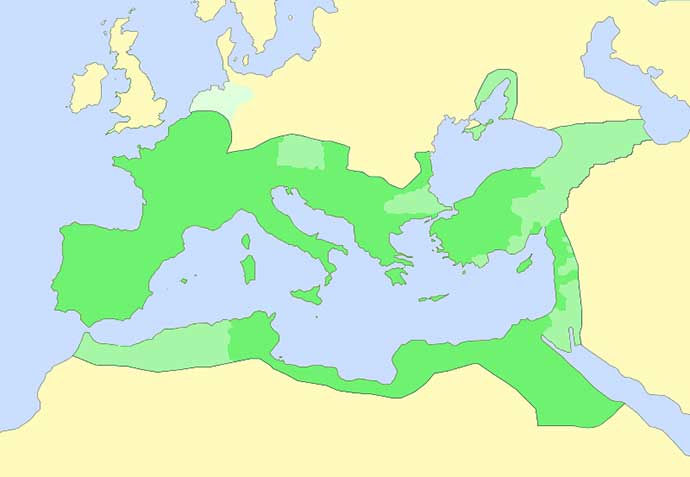
Setting aside civil wars and revolts, the majority of Rome’s military manpower was used against extramural opposition. Therefore, how Rome acted along her frontiers and fought foreign wars directly affected her recruiting practices. While most tenets were formulated under the Republic (Modern arguments have been dominated by whether Rome followed an aggressive imperialism or whether her “territorial expansion was largely unsought” (Rich in Rich and Shipley (1993), 39). The idea of ‘defensive imperialism’ has many high-profile adherents (Mommsen (1877-80); Frank (1914); Badian (1958, 1968); Walbank (1963); Errington (1971)) and remained unchallenged for a century. However, more recently, dissent has emerged (Finley (1978); Hopkins (1978), 25-37; Harris (1979, 1984)).
Whether she sought it or not, Rome’s empire steadily expanded in all directions throughout the second and first centuries BCE. This makes it difficult to attribute anything innately defensive or even organised about Rome’s treatment of her frontiers. What is clear is that these continuous wars would have required considerable manpower. The citizenry was under pressure enough for there to be some suggestion of a shortage of recruits in the latter second century BCE (Rich (1983)), the real architect of Roman frontier policy was Augustus. After solidifying his position as princeps, territorial acquisitions created the provinces of Pannonia, Illyricum and Moesia. This establishing of the Rhine and Danube frontiers suggests some strategic consideration regarding defensible positions. However, limited archaeology suggests that most Augustan bases and forts were made out of wood, indicating that they were not meant to be permanent or for defensive motivations (Wells (1972), 246-247).
The lack of a clear frontier system suggests that Augustus was “not thinking about keeping the barbarians out, but of going out... to conquer the barbarians” (Wells (1972), 246). Augustus may have wished to make the Elbe Rome’s frontier by conquering Germany and Bohemia. However, there is no real evidence (Strabo VII.291 on Augustus forbidding his commanders to cross the Elbe) to suggest that Augustus aimed to make the Elbe-Danube line his final frontier; a frontier that would not have been easily defended (Wells (1972), 249). Suggesting that Augustus’ push to the Elbe was a well-thought out policy rather than a search for glory would attribute a far more comprehensive frontier strategy than is necessary. While rebellion in Illyricum in 6 and the defeat of Teutoberg Walde in 9 undermined Augustus’ plans for Germany, the continued presence of the legions along and beyond the Rhine and Danube shows that the Romans had not abandoned their aggressive stance in Europe.

The same can be said for the east as well. During Augustus’ lifetime three Roman armies had been badly mauled by the Parthians (Crassus’ disastrous defeat at Carrhae in 53BCE, Lucius Decidius Saxa’s humiliation during the Parthian invasion of Syria in 40BCE and Marcus Antonius’ ignominious retreat from Phraaspa in 36BCE all resulted in the loss of legionary eagles) and with the ‘Parthian shot’ being particularly effective against massed Roman infantry, the emperor would not risk an invasion. However, this does not mean Augustus was defensive when it came to east. The four legion-strong garrison of Syria not only highlights the potential Parthian threat but also that Rome never gave up the idea of an Alexandrian thrust towards India. Armenia, due to the victories of Lucullus and Pompeius Magnus, was regarded as being within the Roman sphere and Augustus was willing to march large armies to the Euphrates to back up Roman claims in the area (In 20BCE, a combined show of force from Tiberius and Augustus persuaded Parthia to back down (Suetonius, Tiberius 9; Pompeius Trogus XLII.5.10) and in 1BCE, Gaius Caesar marched his army to the Euphrates to settle a dispute over Armenia (Velleius Paterculus II.101; Tacitus, Ann. II.3)). He and his successors knew that if they needed a major victory to bolster their popularity, the east remained a viable avenue for conquest. Augustus was content to have the Euphrates as a border and to limit the chances of open war with the Parthians, he continued the Republican tradition of positioning friendly states between Rome and her foes (Braund (1984) on Rome’s relations with these allies). Vassals such as Palmyra, Iberia, Commagene, Nabataea, Edessa and Cappadocia kept a dangerous foe at arm’s length. Due to the amorphous nature of Roman authority, these client states were considered Roman territory (Wells (1972), 247).
The main reason for Augustus’ conquests does not belong in the realms of strategy. Augustus knew that “military success was an immediate practical necessity, if he was to establish his regime; it was also the surest way to lasting glory” (Wells (1972), 5). Roman society had always expected her politicians to be militarily successful and Augustus’ answer was to expand in almost every direction. His armies defeated old and well-known adversaries such as Germans, Parthians, Illyrians, Pannonians and Spaniards although the most useful campaigns for the Augustan propaganda machine were those sent to the Fezzan oases in the Sahara, up the Nile to the kingdom of Meroe and Arabian desert to the kingdom of Saba (Augustus, Res Gestae 26; Jones (1970), 50-52). While these campaigns had few tangible results, the Roman army had gone further than it ever had before and defeated new and exotic enemies, giving Augustus immense prestige. These expeditions established the principle that future emperors had to be seen as great conquerors, even if they never actually led the army in person.
However, on his deathbed Augustus is reported to have instructed his heir to keep the Empire within its current limits (Tacitus, Ann. I.11; Dio LVI.33). While Tiberius did allow campaigning in Germany, after five years with few concrete gains further expansion was abandoned. This less belligerent policy was heavily criticised and it does not appear to have been followed by their successors (Tacitus, Ann. I.3; IV.32 accuses Tiberius of incuriosus, which “seems to mean that anyone who did not promote the expansion of the empire was guilty of criminal irresponsibility” (Mann (1979), 177)). Being circled by opportunistic tribes and kingdoms meant that Rome had to remain vigilant and prepared to go on the offensive (Cornell in Rich and Shipley (1993), 142). Also the ‘natural frontiers’ argument is by no means water-tight. The Rhine, Danube and Euphrates do not form effective strategic frontiers as they are not always defendable and had not functioned as an ethnic, linguistic or national boundary (Mann (1974), 513; Birley (1974), 22). They were “initially chosen as a temporary border for reasons of administrative convenience” (Cornell in Rich and Shipley (1993), 142) as further conquests were expected. However, as these conquests failed to materialise, these river frontiers became increasingly fixed.
Bibliography
Arce, J. ‘Frontiers of the late Roman Empire: Perceptions and realities’ in Pohl, W., Wood, I. and Reimitz, H. (eds.) The Transformation of Frontiers. Leiden (2001) 5-13
Badian, E. Foreign Clientelae 264-70BC. Oxford (1958)
Badian, E. Roman Imperialism in the Late Republic. Oxford (1968)
Braund, D. Rome and the Friendly King: The Character of the Client Kingship. London (1984)
Campbell, J.B. The Emperor and the Roman Army 31BC-AD235. Oxford (1984)
Casey, P.J. The Legions of the Later Roman Empire. Cardiff (1991)
Christie, N. ‘Urban defence in later Roman Italy’, in Herring, E., Whitehouse, R. and Wilkins, J. (eds.) Papers of the Fourth Conference of Italian Archaeology 2 London (1991) 185-199
Coello, T. ‘Unit Sizes in the Late Roman Army’, BAR Int. Ser. 645. (1996)
Collingwood Bruce, J. Handbook to the Roman Wall. Newcastle Upon Tyne (1978)
Cornell, T. ‘The end of Roman imperial expansion’ in Rich, J.W. and Shipley, G. War and Society in the Roman World. New York (1993) 139-170
Elton, H. ‘Defining Romans, Barbarians and the Roman Frontier’ in Mathisen, R.W. and Sivan, H.S. (eds.) Shifting Frontiers in Late Antiquity. Aldershot (1996) 126-135
Errington, R.M. The Dawn of Empire: Rome’s Rise to World Power. London (1971)
Ferrill, A. The Fall of the Roman Empire: The Military Explanation. London (1986)
Finley, M.I. ‘Empire in the Graeco-Roman World’, Greece and Rome 25 (1978) 1-15
Frank, T. Roman Imperialism. New York (1914)
Harris, W.V. War and Imperialism in Republican Rome. Oxford (1979)
Harris, W.V. (ed.) The Imperialism of Mid-Republican Rome. Rome (1984) Harrison (1969)
Hopkins, K. Conquerors and Slaves. Cambridge (1978)
Isaac, B. ‘The Meaning of the Terms Limes and Limitanei’, JRS 78 (1988) 121-147
Isaac, B. The Limits of Empire. Oxford (1992)
Johnson, A. Roman Forts of the 1st and 2nd centuries AD in Britain and the German Provinces. London (1983)
Jones, A.H.M. Later Roman Empire 284-602. Oxford (1964)
Jones, A.H.M. Augustus. London (1970)
Keppie, L. The Making of the Roman Army. London (1991)
Lee, A.D. War in Late Antiquity. Oxford (2007)
Luttwak, E.N. The Grand Strategy of the Roman Empire. Baltimore (1976)
Mann, J.C. ‘Power, force and the frontiers of the empire’, JRS 69 (1979), 175-183
Millar, F. The Roman Near East 31BC-AD337. Cambridge (1993)
Mommsen, T. The History of Rome. Berlin (1854-1856) (Dickinson, W.P. translation, 1877-1880)
Petrikovits, H. von. ‘Fortifications in the north-western Roman empire from the third to the fifth centuries AD’, JRS 61 (1971) 178-218
Rich, J.W. ‘The Supposed Roman Manpower Shortage of the Later Second Century BC’, Historia 32 (1983) 287-331
Rich, J.W. ‘Fear, greed and glory: the causes of Roman war-making in the middle Republic’ in Rich, J.W. and Shipley, G. War and Society in the Roman World. New York (1993) 38-68
Salway, P. Roman Britain. Oxford (1981)
Southern, P. and Dixon, K.R. The Late Roman Army. London (1996)
Tomlin, R.S.O. ‘The Legions in the Late Empire’ in Brewer, R.J. (ed.) Roman Fortresses and their Legions. London (2000) 159-178
Wacher, J. The Towns of Roman Britain. London (1974)
Walbank, F.W. ‘Polybius and Rome’s eastern policy’, JRS 53 (1963) 1-13
Wells, C. The German Policy of Augustus. Oxford (1972)
Whittaker, C.R. Frontiers of the Roman Empire: A Social and Economic Study. London (1994)
Whittaker, C.R. Rome and Its Frontiers. London (2004)
Wolfram, H. History of the Goths. Berkeley (1988)
Wolfram, H. The Roman Empire and its Germanic Peoples. London (1997)


Comments