The (Brief) Gothic Takeover of Constantinople I: The Revolt of Tribigild

The sieges, capture and Sack of Rome by the forces Alaric the Goths in 410 has been seen as a major landmark in the fall of the Western Roman Empire. From his writing desk in Bethlehem, St Jerome decried that “My voice sticks in my throat; and, as I dictate, sobs choke my utterance. The City which had taken the whole world was itself taken” (Jerome, Ep.127.12). A little melodramatic, but no less encapsulating of the potential symbolism of the event. After all, it had been almost 800 years since Brennus the Gaul had been the last foreign enemy to capture Rome.
And yet, it may come as a surprise to some that this was not the first Roman imperial capital to be taken over by a Goth-led force in the fifth century. Looking east, the ‘New Rome’ of Constantinople had itself fallen into the hands of a Gothic commander in the form of Gainas ten years before Alaric forced his way into the Eternal City.
The origin of this Gothic takeover of Constantinople in 400 was an attempted forced crossing of the Danube frontier into Roman territory by a group of Ostrogoths under their leader Odotheus in 386. No doubt fleeing the growing control of the Huns on the Ukrainian steppe and the Lower Danube, these Ostrogoths sought entry into the Roman Empire on similar terms to the Visigoths a decade earlier.
Perhaps remembering that that opening of the frontier to Visigothic refugees in 376 had led to the catastrophic Battle of Adrianople two years later and a further four years of attritional Romano-Gothic warfare in the eastern Balkans, the emperor Theodosius I denied these Ostrogoths such an arrangement.

This imperial refusal could have been exactly due to a recognition of the past and what that refusal was likely to bring if the Ostrogoths were desperate enough to seek sanctuary: a forced crossing into Roman territory. You might rightly ask why Theodosius would be willing to risk bringing about an invasion of his lands when a more peaceful entry was presented to him. The answer may be that Theodosius wanted the Ostrogoths to cross the Danube in hostility.
He may have wanted to test the army he had been rebuilding since his promotion to emperor in the aftermath of Adrianople, while a hostile Ostrogothic invasion gave him the excuse to annihilate them, disarm and then settle the survivors with much less trouble, while providing more recruits for his army. The idea of an uncowed Gothic force on Roman territory had been at core of the problems pre- and post-Adrianople and would eventually lead to Alaric’s sacking of Rome. A massacre of other Goths may also provide a lesson to the Visigoths only recently settled on imperial territory.
His petition rejected, Odotheus duly prepared for a forced crossing of the Danube. He was walking straight into a trap... The setter of this trap was Promotus, magister peditum per Thracias. He deployed his forces along the southern bank of the Lower Danube and sent some of his men to Odotheus’ camp on the pretext that they wished to betray the Romans. Instead, these men were to report the Ostrogothic movements and likely to further encourage their crossing and downplay the Roman military presence and its readiness.
Suitably encouraged (and reported on), Odotheus led his Ostrogoths across the Danube, only to find their crossing intercepted by Promotus’ army, very much present and ready, as well as backed by Visigothic auxiliaries and the Danube fleet. The makeshift Ostrogothic canoes were sunk, their occupants drowned, while the army killed those who had made it to shore. In short, it was a massacre (Zosimus IV.38-40). The court poet Claudian depicts the riverine island of Peuce as being piled high with dead bodies, while the mouth of the Danube ran red with the blood of the slain (Claudian, Cos. Hon. IV 633-37).
Despite such colourful court propagandising, evidently some Ostrogoths survived this massacre by Promotus to be transported to Phrygia in Asia Minor. It is likely that these new Ostrogothic settlers provided Theodosius with troops for his civil wars against Magnus Maximus in 388 and Eugenius in 394. It is likely that these Ostrogoths, as well as other Goths, provided good service to the empire as there are numerous men of Gothic origin recorded not only in imperial service but with Roman military rank. And it is around some of these Goths with Roman rank that the story of the Gothic Takeover of Constantinople largely centres.
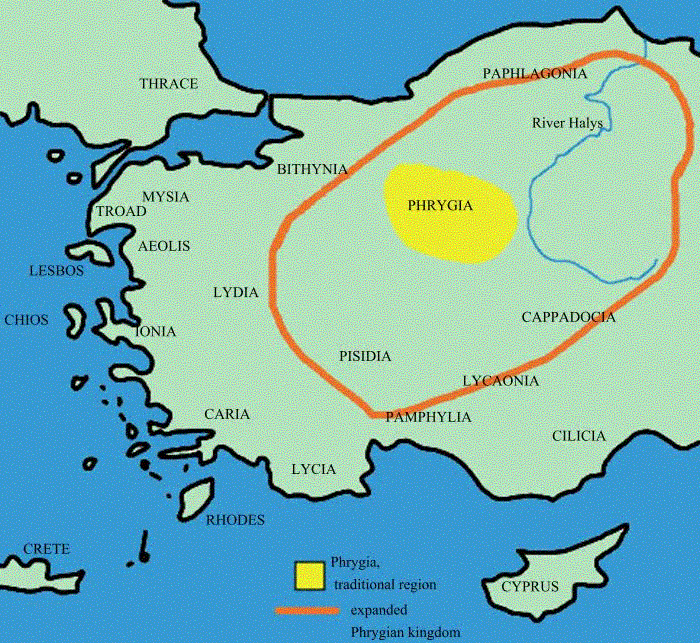
The catalyst for this story was a certain Tribigild, a Greuthungi/Ostrogoth serving in the Roman army with the rank of comes (re militaris?). He was seemingly the commander of a unit of the Ostrogoths settled in Phyrgia and stationed in Nacoleia (Zosimus V.13.2; Philostorgius XI.8; Claudian, in Eutr. II. 153-54, 158-59, 176, 196-97; Socrates, HE VI.6.5; Sozomen, HE XIII.4.2; John of Antioch fr.190; Philostorgius XI.8; Liebeschuetz (1990a), 38 n.63).
In the summer of 399, Tribigild left Constantinople feeling slighted by Eutropius, praepositus sacri cubicularius – essentially the chief minister of the emperor Arcadius – and perhaps the Roman state in general for a lack of good reception and possibly reward for his service in the imperial victory over the Huns in 398. Returning to his men in Phrygia, he roused them in revolt, suggesting perhaps that these Ostrogoths had also felt that their service had been underappreciated and under-rewarded. While his force may have started with an ala of Ostrogothic cavalry, it incorporated other discontented elements such as slaves, deserters and possibly Roman provincials.
Demonstrating his daring, recklessness and cunning (Zosimus V.13.2; Suda K539), Tribigild led the Phrygian Ostrogoths in a series of raids across various provinces of Roman Asia Minor – Phrygia, Lydia, Pamphylia and Pisidia (Zosimus V.13.3-4, 14.5, 25.2; Claudian, In Eutr. II.236-37; Philostorgius XI.8; Socrates, HE VI.6; Sozomen, HE VIII.4).
After Eutropius seemingly failed with an attempt to buy Tribigild’s relenting with an offer of high office (Claudian, In Eutr. II.176, 320-21), another comes, Leo, was dispatched to deal with these renegade Ostrogoths. Some of the sources are overtly hostile to Leo, considering him completely lacking in any military skill and only given the command due to his friendship with Eutropius (Zosimus V.14.2 and Claudian, in Eutr. II.406-408).
Initially, having crossed over to Asia from Constantinople, Leo remained near the coast in a defensive position, only to be ordered by his superiors into the interior to square up to Tribigild. It was on this march that Claudian, In Eutr. II.417-422 would have it that Leo revealed himself as an awful commander, failing to maintain any sort of discipline on the march or in camp. Entering Pamphylia, Leo’s disorganised column found itself under attack, but from barbarian troops sent to help him… (Zosimus V.17.2). It may be that Tribigild was able to subvert the loyalty of other barbarians serving in these imperial units; however, as will be seen later, some sources suspected more insidious aid being fed to Tribigild’s Ostrogoths. Depleted and disorganised, Leo’s column was then attacked and defeated by Tribigild’s rebel Ostrogoths. Leo himself dropped dead during the subsequent flight (Eunapius fr.76; Claudian, in Eutr. II.432-61).
Despite this victory over imperial forces, Tribigild was not having it all his own way in the field. A certain Valentinus, a native of Selge and estate owner in Pamphylia of some military experience but no official position, organised his ỏικέται, local farmers, slaves and probably some police forces into a militia to oppose the Ostrogoth raiders. Valentinus ambushed Tribigild’s men near Selge, with the Gothic leader seemingly only escaping through bribery. This Pamphylian militia continued to harass Tribigild after their success at Selge, forcing him to retreat back to Phrygia (Zosimus V.15.5, 16.1-5, 17.2).
This setback may have encouraged more drastic action in Tribigild. Before 399 was out, the rebel Ostrogoths were marching towards the imperial capital. There may have been another aspect to this move by Tribigild besides the seemingly obvious attempt to take the city. Several of the sources thought that the Ostrogothic rebel was receiving considerable insider support, to the point that the entire revolt was orchestrated for political ends (Zosimus V.13.2, 15.3, 17.2, 18.4; Eunapius fr.75; Socrates VI.6.5; Sozomen VIII.4.2; Philostorgius XI.8). The focus of this reputed collusion was Leo’s superior and the man now charged with putting down the revolt of Tribigild, Gainas.
But who was this supposed conspirator? Gainas is recorded as being born a Goth north of the Danube (Zosimus V.21.9; John of Antioch fr.190; Philostorgius XI.8; Sozomen VIII.4.1; Socrates VI.6.1; Eunapius fr.82), although there is little to suggest when and no concrete evidence for what kind of Goth he was. Gainas is said to have been a relative of Tribigild (Socrates VI.6.5; Sozomen VIII.4.2; John of Antioch fr.190 suggests that Tribigild was a subordinate of Gainas), which could suggest Ostrogothic origins; but then despite the recording of Claudian and Philostorgius, Tribigild was not necessarily a Greuthungi/Ostrogoth. Him leading Ostrogoths in rebellion is not definitive evidence of his tribal origin.
Even if both Gainas and Tribigild were both Greuthungi/Ostrogoths, that does not give a much clearer picture of when they came into the empire. Significant groups of Ostrogoths crossed the Danube at various points throughout the 370s and 380s. That said, the largest Ostrogothic group to enter the empire in the last quarter of the fourth century was likely that of 386, which led to the settling of the Pamphylian Ostrogoths. This would make it the more likely origin of both Gainas and Tribigild; however, they could have instead enlisted in the Roman army as individuals rather as part of a defeated tribal group.
Caution must also be taken over claiming that the Gothic origins of both Tribigild and Gainas makes them more likely to ally with each other if there was no familial connection. Germanic nationalism was not necessarily a strong bond, particularly amongst men who had served in the Roman army and even the corridors of power in Constantinople, where they were extensively Romanised. That said, there was some suggestion of a pro-Gothic vs anti-Gothic/Hellenist feud in the upper echelons of Constantinopolitan politics in the last years of the fourth century.
The suggestion that Tribigild was a subordinate of Gainas (John of Antioch fr.190) could not only refer to Gainas’ increasingly high rank, but perhaps also how Tribigild served under Gainas perhaps during the civil war between Theodosius and Eugenius. Synesius, de prov. 108B refers to general possibly to be identified as Gainas, which suggests he was married to a barbarian woman and had several children.

Wherever and whenever he came to be in the empire, Gainas enlisted in the Roman army as a common soldier. He demonstrated enough skill in war to win swift promotion to a position of command. This could suggest that Gainas led a Gothic group within the Roman army. He is certainly recorded as a commander of Theodosius’ barbarian foederati troops alongside Saul and Bacurius during the campaign against Eugenius and Arbogast in 394 (Zosimus IV.57.2, 58.2; John of Antioch fr.187). By 395, perhaps after his service to Theodosius in the Frigidus campaign, Gainas had become a comes (rei militaris) (Marcellinus Comes s.a.395, 399; Jordanes, Rom. 319, 320; Get. 176; John of Antioch fr.190).
This put him high up in the leadership of the eastern field army at the time of Theodosius’ death. On the connivance of Stilicho, when Gainas helped lead the eastern forces back to Constantinople in 395, he had his men attack and kill Rufinus, the praetorian prefect in the east and effective power behind Arcadius’ throne (Zosimus V.7.4-6; Philostorgius XI.8; John of Antioch fr.190; Marcellinus Comes s.a. 395; Jordanes, Rom. 319).
This left Gainas in a powerful political, as well as military, position; to the point that in 399 it was claimed that Gainas was part of the planning of the revolt of Tribigild. This was supposedly because Gainas was jealous of Eutropius, who had succeeded Rufinus as Arcadius’ chief advisor (Zosimus V.13.1-2, 17.4; Eunapius fr.75; Marcellinus Comes s.a.399). It could well be imagined that Gainas, influenced by Stilicho’s powerful position in the west, did not take kindly to having to follow orders from the civilian eunuch Eutropius. Any such personal anger cannot have been helped if Gainas also felt that his own service had not been suitably rewarded. Gainas may well have felt that he should have succeeded Rufinus as the power behind the eastern throne rather a eunuch politician. Could Gainas even have been promised such a promotion during whatever negotiations he took part in with Stilicho which led to the assassination of Rufinus?
It may not be certain or even correct that Gainas was behind aspects of the revolt of Tribigild, but he would be the ultimate (albeit short-lived) beneficiary of the disruption it caused at the centre of the Eastern Roman Empire. And with that, the ‘revolt of Tribigild’ effectively morphs into the subject of part II of this series… the ‘tyranny of Gainas’…


Comments