Head on a Pike: Some Coins of Maximinus Thrax

In the face of repeated rebellion at the centre of his empire, Maximinus Thrax emerged from his winter quarters in Sirmium and marched on Italy, aiming to deal with the rebellious Senate and its dual usurpers, Pupienus and Balbinus.
Crossing into northern Italy with no opposition, Maximinus thought it would be a simple task to reach Rome; however, he soon received word that the largest city in the area, Aquileia, had shut its gates to the Pannonian legions he had sent on ahead. Initially in poor state, the senatorial leaders of Aquileia – Rutilius Pudens Crispinus and Tullus Menophilus – had seen to the repairing of the city walls, the gathering of supplies, securing of the ample water supply and the rallying of the Aquileian garrison to resist (Herodian VIII.2).
Despite their superiority in numbers, it soon became clear that Maximinus’ men were not prepared for a prolonged siege, physically or mentally. Having thought that Aquileia would not resist at all, it was a great shock that it had resisted for weeks, even months. And the longer the siege went on, the more confident the Aquileians seemed to be getting.
This led Maximinus to berate his soldiers and generals as acting cowardly in the face of armed resistance. This imperial insult was compounded by the growing issue of supplies. Again highlighting how they did not expect to be held up long at Aquileia, Maximinus’ men had devastated the surrounding countryside. This failed on two fronts – Aquileia had already built up its own stores and now the besieging army had nowhere to gather resources from, particularly as senatorial forces “blocked all the roads of Italy by erecting walls provided with narrow gates” (Herodian VIII.5.4). This took its toll to the point that “many died of starvation” (Herodian VIII.5.4). Something had to be done. And that something was ‘regime change’.
During a lull in the fighting, members of the Legio II Parthica (the Italian garrison legion) approached the emperor’s tent and tore down his standard, being allowed to do so by the imperial bodyguard, which was also in on the plot. So, when Maximinus and his son came out to see what the racket was about, they killed them both (Herodian VIII.5.8-9; HA Maximini 23.6).
It is not completely clear what happened to the bodies of the Maximini as both Herodian and the Historia Augusta do not make it clear if they are talking about the bodies of the murdered emperors or those of some of their imperial underlings either being ‘trampled and mutilated’ in the imperial camp at Aquileia (Herodian VIII.5.9) or they were taken to Rome and cast into the Tiber as common criminals (HA Maximini 31.5).
However, the main (grizzly) focus of this piece is what happened to their heads. And in that, Herodian and the Historia Augusta share a common usage – they were sent to Rome (Herodian VIII.5.9; HA Maximini 23.6), where they will have been presented to the other two emperors, Pupienus and Balbinus, and the Senate and then displayed publicly in triumph and warning to what happens to tyrants and enemies of the People/Senate.
The Historia Augusta adds in some extra detail, stating that the removed heads were placed on poles and shown to the Aquileians, before then being taken to Rome, where they may have been burned in the Campus Martius after being publicly displayed (HA Maximini 23.6, 31.5).
And as you can tell from the title of this piece, it is this idea that Maximinus’ head was put on a pole and left in the open that is the main focus. There will have been many eyewitnesses to this grizzly sight, given that it was likely placed in a public space such as the aforementioned Campus Martius or the Forum Romanun – that was the point. People needed to know what happened.
It could be that at least one eyewitness decided to commemorate the occasion and found the medium for that commemoration jangling in his pocket in the form of a coin of the deceased and decaying emperor before him.
Taking the coin out of his pocket, this numismatic ‘artist’ proceeded to recreate the grotesquery he had seen by carving away the shoulders and neck of the bust on the coin’s obverse to make it appear as if it depicted Maximinus’ head on a pole.
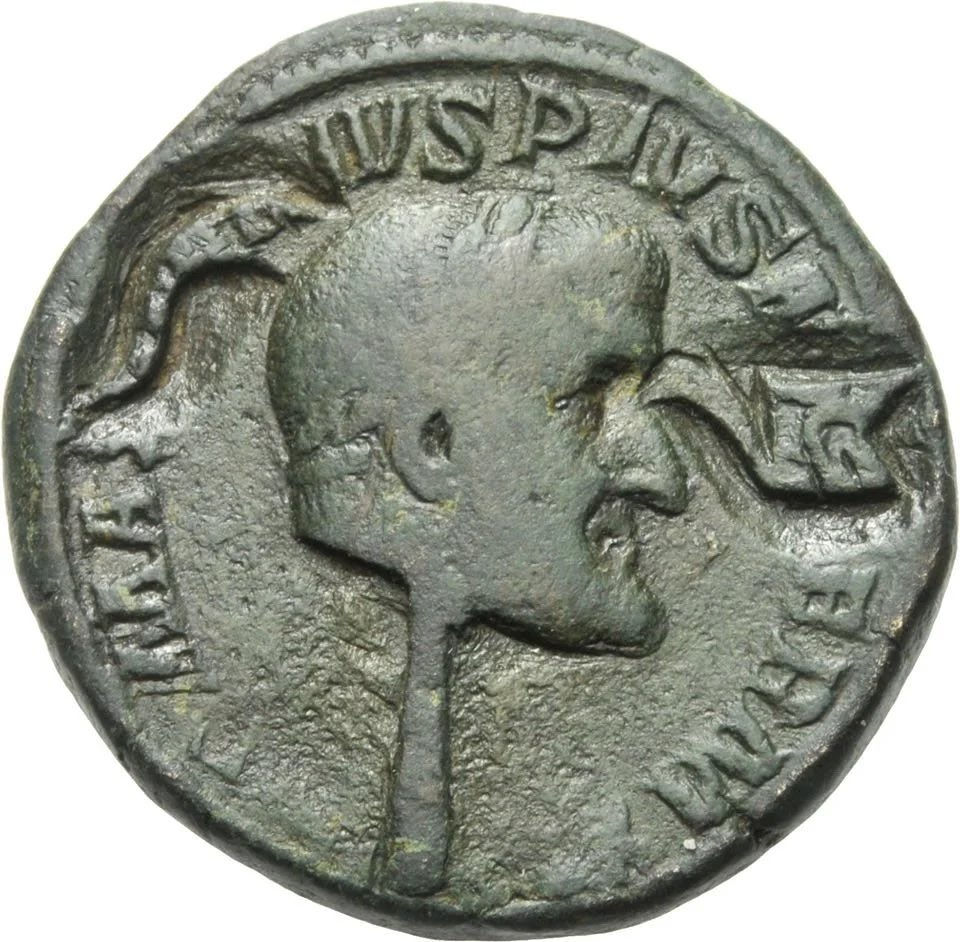
There is more to this particular ‘carving’ than just an imperial head on a pole. As can be seen, there appears to have been some attempt to destroy part of the legend of Maximinus’ name and titles, possibly as part of a damnatio memoriae; however, it has been suggested that there is something specific being added to the dead emperor’s head, reflecting the dark humour or even the reality of what our numismatic ‘artist’ saw in Rome. To the right, it could be that he has carved a bird, most likely a crow, pecking at Maximinus’ eyes, while to the left, it has been suggested that a worm has been carved exiting the back of the emperor’s head...
The site of birds picking at Maximinus’ head could be reflected in Herodian’s description of the fate of the bodies of the Maximini and/or their supporters – “Their bodies were handed over to those who wished to trample and mutilate them, after which the corpses were exposed to the birds and dogs” (Herodian VIII.5.9).
It must be said that the coin presented above is not the only one known having been carved to make it look like Maximinus’ head was on a pole.

That we have two such coins makes it likely that there were more, as it is extremely unlikely that the only two coins carved in such a way would survive down to the modern day. This reflects the success of senatorial and Gordian propaganda in denigrating Maximinus Thrax as a tyrant who needed to be removed.
And of course, defacing coins was hardly a new thing, whether it be for imperial propagandist reasons such as Caracalla’s attempted erasure of Geta, ritualised or religious reasons or even general graffiti.
Bibliography
Pearson, P. Maximinus Thrax: From Common Soldier to Emperor of Rome. Barnsley (2022).
Rea, J. R. ‘O. Leid. 144 and the Chronology of A.D. 238’, ZPE 9 (1972) 1-19.


Comments